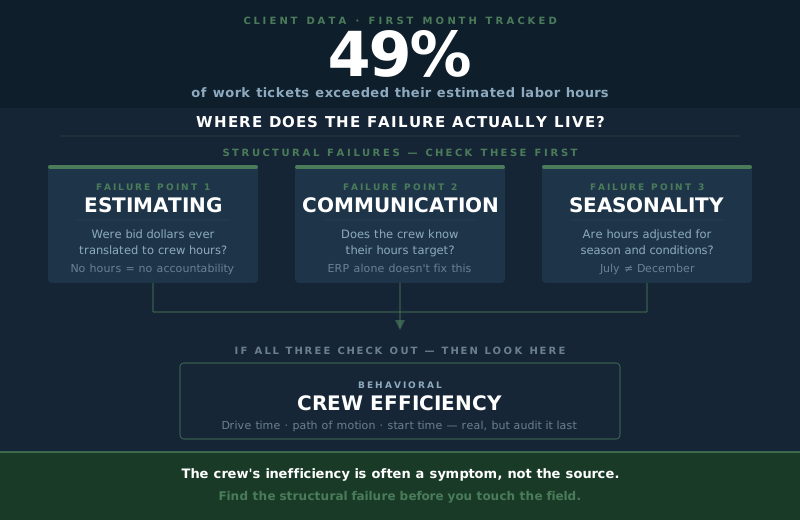
In the first month one client tracked it, 49% of work tickets exceeded estimated labor hours. The gut instinct is to drill into the crews. That’s often the wrong move — three structural failures have to be ruled out first.
Read the post →
The link between a field supervisor cutting a PO and a company's ability to fund equipment without financing runs through free cash flow. How purchase order timing drives cash availability — with the math on what an 8-day slip actually costs.
Read the post →
Three parties have fingerprints on every job-costing outcome: estimating, finance, and execution. Most companies only question one. An Enhanced Post-Mortem that compares estimate, schedule of values, and actual financials side by side is the structure that finds the true source of failure.
Read the post →
Storm cleanup is not in kind with landscape maintenance — it requires different equipment, carries higher risk, and generates disposal costs that a standard contract cannot absorb. What operators need in a separate agreement, and why it must be signed before hurricane season.
Read the post →
Two configurations worth examining today — direct-report site storage and route-based 60" robotic — with the math on labor savings, gross margin improvement, and how both connect to a multi-year escalation strategy.
Read the post →
Most landscape companies carry a supervisory layer that costs more than it produces. Restructuring that accountability to crew leaders — with a corresponding raise — generates $133,000 in redeployable value and a stronger operation.
Read the post →
Most landscape companies pay operations manager salaries for production management output. The gap between those two roles — measured through crew efficiency and route density — is worth $147,800 to $157,800 per year.
Read the post →
The WIP report is a standard financial document — but the decisions it surfaces are decidedly operational. A material purchase that does not show up in job costs is not an accounting problem. It is a field problem.
Read the post →
A backlog tells you what work is coming. A Revenue Planner tells you when it arrives — and converts four hidden opportunities into measurable margin and EBITDA.
Read the post →
Contract renewals are won or lost in the months before the conversation happens. Narrative seeding, timing, and incremental escalation discussions are the mechanics that protect your margin and enterprise value.
Read the post →
Most landscape owners don’t know which metric a buyer will use to value their business — and the difference can be hundreds of thousands of dollars. Here’s how to think about it.
Read the post →
The letter of intent is the most important document most landscape owners have never read carefully. What it means, what it locks in, and what you can still negotiate afterward.
Read the post →
Buyers prefer asset sales. Sellers prefer stock sales. Understanding why — and what each structure means for what you net — is non-negotiable before you sit across from a buyer.
Read the post →
Working capital kills more landscape exits than valuation disputes do. Buyers require a normalized level at close — and most sellers are surprised to learn what that number is.
Read the post →
Most landscape operators use markup and margin interchangeably. They’re not the same thing — and confusing them creates systematic underbidding that compounds across every job on the book.
Read the post →
What should gross margin look like for landscape maintenance? How does it compare across maintenance, enhancements, construction, and turf? Real benchmarks from operators in this industry.
Read the post →
Ten minutes of avoidable rollout delay per crew member costs a 30-person operation over $31,000 a year — and connects directly to enterprise value at exit.
Read the post →
Revenue weight, Opex coverage, gateway value, and enhancement penetration rate — the four measures that reveal what a recurring maintenance contract is actually worth.
Read the post →
Every dollar of recurring maintenance revenue lost takes $1.40 with it once enhancement revenue is included. The math makes trust a financial priority, not just a leadership value.
Read the post →
Change and profitability don’t scale together indefinitely. The financial model and the ethical case for managing pace reach the same conclusion.
Read the post →
A $55,000 robotic mower can raise a route’s gross margin from 40% to 56.7% by year two — and fund a meaningful pay increase for the crew member working alongside it.
Read the post →
Full-service contracts in Florida require 12 pruning cycles, 42–52 mow visits, and 12 irrigation wet checks per year. Operators pricing from Mid-Atlantic experience will underbid the labor on the first proposal.
Read the post →
Full-service contracts offer predictable revenue, stronger retention, and higher enterprise value. They also carry scope creep, salesperson risk, and Opex exposure that unprepared operators absorb month after month.
Read the post →