A backlog is standard lingo and practice for construction folks. The goal is to ensure that the company has future work lined up to keep everyone working and enough money in the coming months to stay aligned to the budget. The challenge is that construction work revenue flows in lumpy. There is operational opportunity within the challenge, and planning helps us convert a challenge into an opportunity.
There are two ways construction revenue is lumpy: (1) on a monthly basis and (2) by project. In every project, there are revenue inflow durations that are more intense than others. Usually, these revenue-intensive durations are also capital intensive. This means that there must be both a capital management plan and a revenue plan. Revenue inflow, for our financial folks, is revenue recognition (ASC 606); capital planning is part of cash-flow management. On the monthly basis, since projects and phases/milestones to those projects make up the monthly revenue basis, it’s obvious that monthly revenue is lumpy as well.
We built a Revenue Planner to address the lumpiness not by removing it but by identifying opportunity in advance, and there are a few different ways opportunity arises when we think far in advance. Standard fare for backlog management — and we are writing this from the viewpoint of a subcontractor under a General Contractor rather than the General Contractor’s backlog management — is to build out revenue for the coming year month by month. This is the baseline for the Revenue Planner. All subcontracts must be scrubbed for their start dates for the subcontractor’s scope timing, and those that do not have start date schedules within them require a call or email to get some idea about timing.
Building the Deviation Analysis
As we build out this Revenue Planner by contractual start date, we also need to do a deep dive into subcontracts we already performed in the past. We compare those contractual start dates to when we actually started the job in earnest (we say in earnest because there is incidental or very small revenue capture that may happen months before the job really starts, such as with sleeves (conduit)). This provides how much deviation we can expect from a scheduled start date to when we most likely will start the job in earnest. This still will only get us a ballpark of how the revenue will come in since subcontract start dates modified by historical deviation will not guarantee that future pattern.
“Past start date behavior does not guarantee it will occur the same in the future.” The Revenue Planner is predictive but not a crystal ball. Its task is to provide a pathway by which to make informed decisions about revenue recognition expectations, capacity planning, cashflow management, and to suggest opportunities.
This makes us think of our years in financial planning: “Past results do not guarantee future performance, investing implies risk.” We should say the same for the Revenue Planner so that we are not naïve. The Revenue Planner is predictive but not a crystal ball. Its task is to provide a pathway by which to make informed decisions about revenue recognition expectations, capacity planning, cashflow management, and to suggest opportunities.
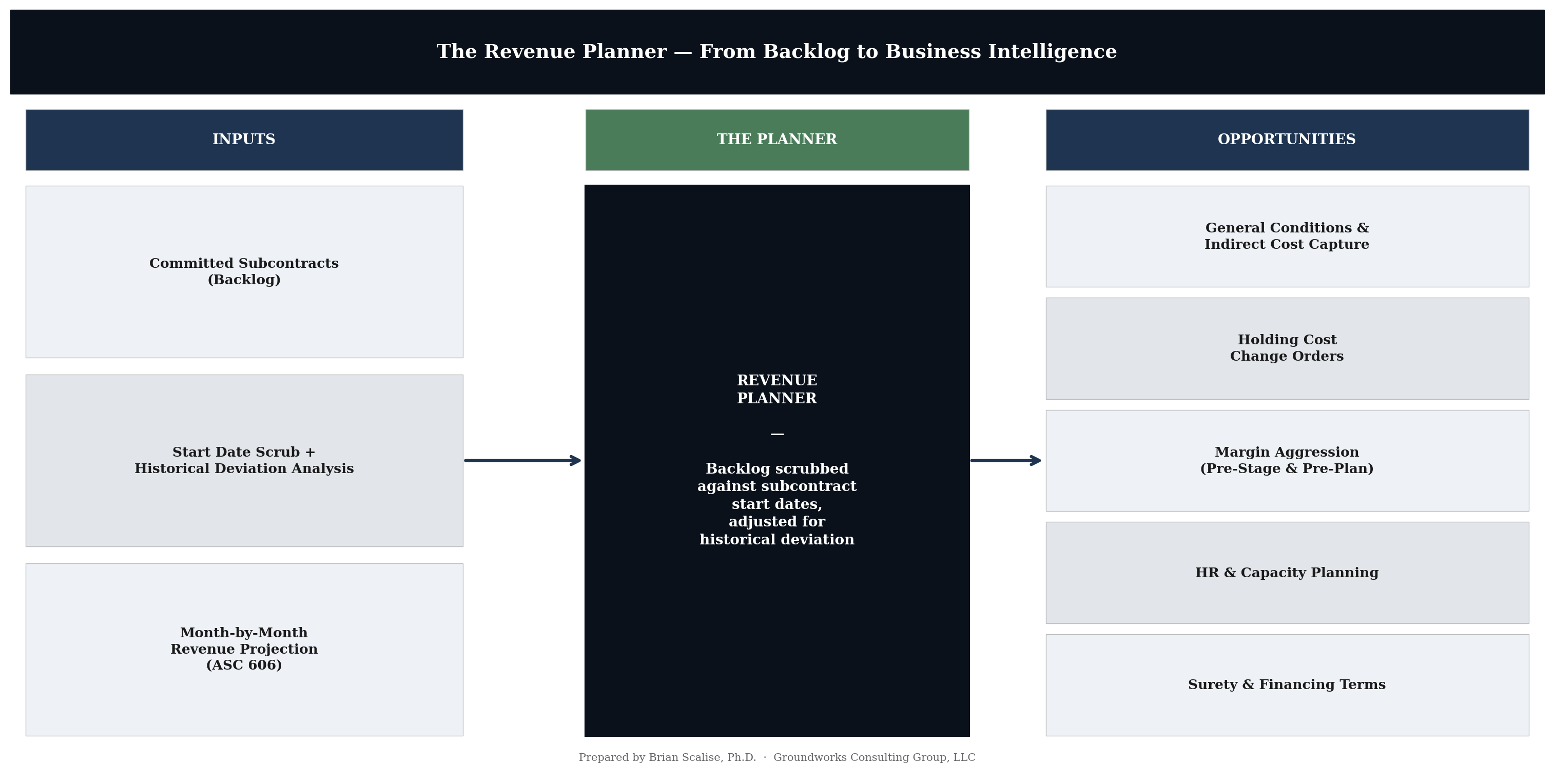
The Revenue Planner framework — from backlog to business intelligence.
Opportunities
We are now ready to move into the opportunities that arise from this process. It is imperative to understand that these opportunities convert into headaches or problems if they are not thought through in advance. One disclaimer worth stating here: some of them can remain opportunities just by the planning, but others have a human element involved with the GC or the Client (if working directly for an Owner) that is utterly unknowable — even the best planning cannot control or overcome human arbitrariness.
General Conditions & Indirect Cost Capture
During the revenue planning, each subcontract has the GC’s or Owner’s SOV (schedule of values) that dictates the service lines (or job scope) to be billed against as work is completed on a % of work in progress vs. work completed. For every job that has or allows for General Conditions or other indirect costs to be billed that either (a) are not named explicitly in the GC’s or Owner’s SOV or (b) are line-itemed on the SOV but require careful project management to capture in-flight, these are identified in the Revenue Planner as such.
For (a), a phone call is needed in advance to prevent a pay-app being rejected since the billed amount on a service line will imply a % of the General Conditions or Indirect Costs. Without the call, this is ripe to be rejected since it will look like we just did our math wrong when we did our billing. In instances where a note can be written in — in more historic, less automated pay app submissions — this may be an alternative to the call. This planning allows for more accurate revenue recognition, which directly positively impacts cash-flow management since more revenue is recognized leading to earlier payment than if we recognized it later. For (b), a callout during the handoff meeting with the project manager is often enough to capture the revenue.
The operational benefit to predicting this revenue coming in is tied to capacity planning. If we know in advance that additional revenue is forthcoming in, say May for instance, than in July, the operational folks can rely on additional resources sooner, allowing for better launching into projects than on the fly would allow.
Holding Cost Change Orders
There is the opportunity for collecting holding cost Change Orders — and we must equally realize the risk in it. If the contractual start date for a subcontractor’s scope is pushed, and the sub is holding materials for that job at the start date — which should be the case if advanced planning is happening — they can submit documentation and pictures to justify holding cost Change Orders. For those in the landscaping space dealing with Live Goods, this is a significant way to mitigate Live Goods’ holding risk. Most landscapers cannot upkeep their Live Goods’ stock at the same quality as the Nursery from which the Live Goods come, which means they have a shelf life. This submission for Change Order holding costs can factor in a 10% warranty on the plant material held.
The risk is that a subcontractor may erode goodwill with the GC/Owner. Two things are put at risk: (1) future revenue with that GC/Owner if they come to believe the holding COs are petty, unjustified, or an attempt to gouge them; and (2) the GC/Owner may bill the sub for delays if the GC says, “Hey, we are ready for you to start on this day now,” and the sub cannot begin work at that time or at least soon after. This is a tit-for-tat scenario that is a real risk, so these COs must be utilized with this level of business acumen behind them to manage risk appropriately.
Margin Aggression
While doing the Revenue Planning, we will be able to see well in advance jobs that have a clear runway. These are jobs where there is ample room to stage in advance, before crews arrive, and that are open and clear of obstacles that would prevent production at an increased rate. In the Landscape Industry, these jobs are sometimes called “truck-to-holes” jobs because the site is open enough to pre-plan, pre-stage, and to pre-dig before materials ever arrive. This eliminates the dreaded double or tripling of handling of materials (which has a big price tag on it). This opportunity is termed Margin Aggression because the only thing impeding our ability to achieve much better margins on this job is our failure to identify that job and pre-plan it accordingly.
HR & Capacity Planning
The Revenue Planner allows vision into both total jobs that can be running at one time and the staff required (with specific job skills) for those jobs. Equipment or Capital Expenses can bottleneck jobs, along with Surety considerations, so HR is not the only restrictor on capacity. Capital-intensive jobs can be seen in advance, leading to the Accounting Department doing a concentrated push to collect dollars in DSO/AR (Days Sales Outstanding/Accounts Receivable) 60 days in advance of that job starting.
The specific trade skills needed for certain jobs along with the labor dollars allocated to that job will get highlighted in the Revenue Planner; these details can be sent to the HR department long before that job starts, giving them time to find the skills and the best candidates. This is hugely important since finding labor in today’s market can be tough, and it is one of the biggest risks to failing on a job — which leads to future revenue risk (or even current if things go bad enough). This also entails brand risk, which is very difficult to reclaim in comparison to how quickly it can be lost.
The Broader Case: Surety and Financing
A backlog is a revenue outlay. A Revenue Planner identifies challenges and converts them into opportunities. Every piece of the business gets benefit from the time well spent in doing the work to put the Planner together. HR, Cashflow, Sales, EBITDA (net profit), Revenue Recognition, and Job-Costing are all meaningfully impacted. Planning makes a material difference in the numbers. It’s proactive rather than reactive.
Financing and Surety considerations will also get meaningful benefit from this Planner if done well. Surety companies are asking specifically about capacity ability, so this artifact will do real work in that room — a well-documented Revenue Planner gives a surety agent something concrete to underwrite rather than a backlog number alone. Construction revenue will be earned either through a plan with added opportunities or through gritted teeth in every reactive mitigation of something going off the unplanned rails.
Build the Financial Controls Behind Your Construction Operation
GCG works with landscape and construction operators on revenue planning, job costing, WIP management, and the financial disciplines that protect margin from estimate to close. Start with the free assessment.
Take the Free Assessment