Daily jobs go over hours for a variety of reasons, but the gut instinct is to drill into the crews. That instinct can be well founded — but the failure may originate somewhere else entirely. To solve it, you need to find the source rather than address a symptom. By “daily jobs,” this applies to any crew task: a route stop, a project phase, a service ticket. Some crews carry multiple tasks in a day, and each should be treated as its own job with its own hours target.
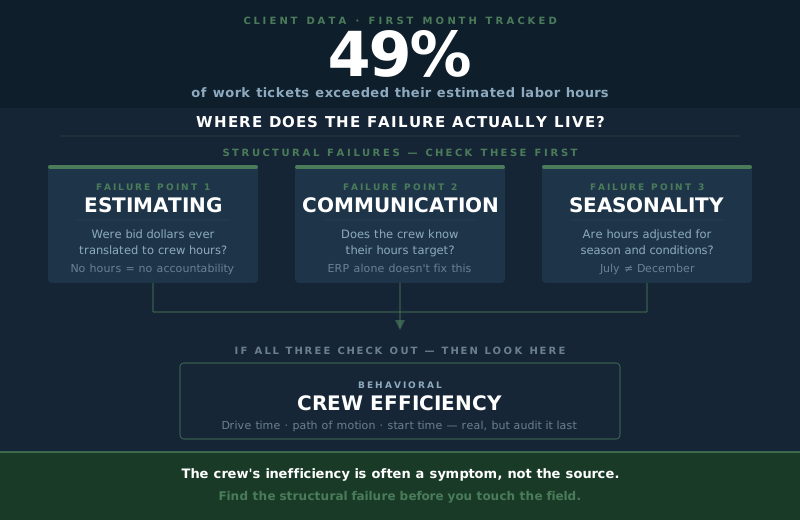
Three structural failure points exist before crew behavior ever enters the analysis. Understanding which one is the actual source changes everything about how you respond to it.
The Baseline You Need First
Before any of the three failure points can be evaluated, there is a prerequisite: expected hours must be recorded somewhere, and someone must be comparing them against actual hours logged. This can be done in a professional ERP, in a spreadsheet, or on paper — the format matters less than the discipline. The crew leader will understand hours. Having that same person understand the dollar cost of a property or job task is unrealistic as a management mechanism. Hours are the right unit of communication at the field level. The simpler the standard, the less risk it gets miscommunicated.
If no hours target exists — if the bid was priced and pushed out the door without translating those dollars into hours — there is nothing to compare against and no basis for accountability. That is where the audit begins.
Failure Point 1: Estimating
When a maintenance contract or project is bid — whether by an owner, a salesperson, or an estimator — the resulting price is often never translated into the hours a crew should hit. The estimator may be excellent at pricing. That skill does not automatically produce a field-ready hours target. If the crew goes over labor cost on a property and no one built an hours expectation from the estimate, the crew cannot be held accountable for missing a standard they were never given.
Before concluding the crew is inefficient, ask whether the estimating process produces hours — not just dollars. If it does not, the structural fix is upstream, and applying pressure to the field produces nothing except frustration in the people you need to retain.
Failure Point 2: Communication
If expected hours are recorded somewhere, the next question is whether the crew knows what they are. A certain way to have a crew exceed their hours is to leave them unaware of the target. Even a well-configured ERP does not solve this automatically. The ticket may carry the hours, but if the crew leader does not know to look for them — or if no one has made that lookup fast and simple — the information is not functionally available at the point of execution.
Before concluding the crew is inefficient, confirm the hours were communicated clearly, in a form the crew leader can check without friction, before the job started.
“The crew’s inefficiency might not be the source of the failure. It might be the symptom of a structural failure that lives much further up the organization.”
Failure Point 3: Seasonality
This is the failure point most commonly overlooked — and the most revealing about whether the people setting hours targets have ever worked in the field. Carrying a weed-eater in high heat and humidity produces a materially different work pace than the same task in mild fall conditions. If the hours targets built into work tickets do not account for this, they will run over consistently during summer months. That is not crew inefficiency. That is a structural mismatch between the standard and the conditions it was designed for.
Seasonality also has budget-level implications. If revenue is billed evenly across fixed-price maintenance contracts, the way labor is actually consumed varies significantly by season. Someone has to think through this during capacity planning — whether the hours saved in the winter have been redeployed to support the heavier-labor summer months. If not, the operator ends up pushing crews to move faster when the conditions are at their worst. Crew leader retention is a direct input to brand strength and enterprise valuation. Plan the year, not just the month.
And Yes — Sometimes It Really Is the Crew
After all three structural failure points have been audited and cleared, field behavior is the right place to look. There is genuine inefficiency that lives at the crew level, and it is worth finding. The audit at that level includes:
These are real, measurable, and correctable. The discipline is auditing them in the right order — structural failure points first, behavioral ones after. Crew efficiency speaks to the entire company’s operational organization. A company that goes straight to the field without auditing its own estimating, communication, and seasonal planning is addressing a symptom and leaving the source intact. It may surprise you where the failure actually resides.
Build the Operational Systems That Find the Real Failures
GCG works with landscape and construction operators on the field controls, labor management discipline, and performance metrics that surface failure at its source. Start with the free Business Health Assessment.
Take the Free Assessment